


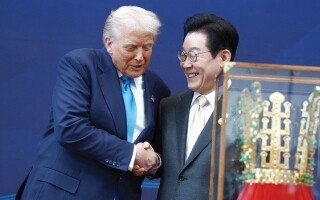
When South Korean President Lee Jae-myung gifted US President Donald Trump a golden crown during Trump's visit to Gyeongju, South Korea, last October, American progressives condemned the gesture as 'kowtowing' and 'flattery' from Seoul. The host of 'The Daily Show' stated that this gesture from South Korea 'does not help' efforts to remove Trump's 'king' image, which Americans are trying to dismantle.
Six weeks later, Seoul's national security strategy clarified Seoul's calculations, indicating that the 'crown' gave it room to maneuver in dealing with Trump and his demands, which Seoul deemed excessive.
While Washington demanded that Seoul expand South Korea's 'strategic flexibility' in response to any Taiwan-related emergency and allocate much greater resources for collective defense, Seoul secured tariff reductions, a nuclear submarine agreement, and, most importantly, enough time to resist being 'dragged' into a conflict with Taiwan it does not want to be involved in, especially since it has no interest in such a conflict and in confronting a great power like China, which is also a vital trading partner.
Managing the Powerful We can understand the 'We don't want kings' protests that swept through US cities for several days, and we can understand why American progressives criticized Seoul's move. It appeared as submission, and everyone was against it.
But from South Korea's perspective, the matter is entirely different, as it is one way of protecting its interests in the face of a leader from a massive and demanding country. It was the final chapter in a very old plan titled 'Managing the Powerful to Ensure the Survival of the Weak.'
This issue deserves a second look, especially now, as President Lee Jae-myung's administration seeks what it calls 'pragmatic diplomacy focused on national interests' amid unprecedented American pressure.
South Korean reactions transcended usual political divides and turned to dark historical humor: 'You Americans elected him, and we're the ones who have to deal with him,' as browsing through Korean comments under the viral video reveals the prevailing mood there.
The Golden Child To understand this, let's look at Trump's nickname in South Korea: 'Teo-jok-ai,' a play on the term 'geom-jok-i' or 'golden child' from a popular reality show about children with severe behavioral challenges, where the goal is not punishment but managing behavior for the family's benefit. In this context, the golden crown is merely a performance aimed at a status-obsessed individual.
Here, one cannot rely on logic in every meeting with a volatile leader; instead, incentives are designed to ensure the country's needs are met, especially when these needs include avoiding entanglement in regional conflicts outside the Korean Peninsula, in which it has no stake and which do not serve its interests at all.
Between a Deal and a Partnership The sarcasm in the US was biting for a practical reason: commentators say South Korea must 'pay what Trump demands.' The framework announced in Gyeongju includes gradual investments of $350 billion, cooperation in shipbuilding, and tariff reductions for South Korean automakers.
No final agreement was signed, but the overall picture was important: Seoul showed it was willing to pay for concessions Trump values. Yet, as reported by the 'Asia Times,' Trump continues to pressure for increased cost-sharing on defense, reframing the alliance as a trade deal rather than a security partnership.
This number recalls the deep 1997-1998 Asian Financial Crisis, where Seoul's depleted foreign exchange reserves forced it to accept a humiliating bailout plan, mass layoffs, and what many call a 'lost decade.' In truth, the world's richest country demanding 'payment' from a small country does not look like a tolerable joke but rather like a rich man extorting a poor man, demanding his family's savings as coins.
One can mock the 'crown' as medieval, and it precisely represents this type of risk management: that is, feigned submission to ensure actual independence. Trump allowed South Korea to build a nuclear submarine to be constructed in Philadelphia.
Its feasibility remains uncertain, but its symbolic meaning was clear: Seoul gained a deterrent capability focused on North Korea and Chinese submarines, not Taiwan. The wisdom of this gamble remains debatable, and describing it as anti-democratic misses the point.
The Path of Action South Korea has chosen a path that may seem 'humiliating' to many American readers, but it looks practical to many South Koreans across the spectrum. Democracy looks different when a nation faces a nuclear neighbor across a demilitarized zone and depends on a key trading partner capable of exerting real economic pressure.
The US can maintain its ideological cohesion, while South Korea must maintain its strategic position.
For six centuries, the Confucian principle in Korea held that a ruler's right to rule stems from serving the people, as a leader who demands tribute and ignores others' well-being is unfit to rule. When South Koreans gifted Trump the crown, they did not abandon this principle; they were reflecting America's power, saying in essence, 'You reject kings at home yet act like empires abroad,' while carving out space to protect their families and industries.
In reality, what appeared as flattery to American progressives was risk management for Seoul. The 'crown' gave it 'breathing room' to resist broader Washington regional demands—demands, as the 'Asia Times' notes, that threaten to push South Korea to the front line between great powers.
From the Asia Times Confusing Survival Strategies with Submission The 'Asia Times' writes: If Americans truly reject monarchy, the harder question is not why South Koreans staged that embarrassing ceremony, but why we rush to expect submission from weaker nations and rush to label their survival tactics as 'loyalty,' when these tactics are often the price of living in a dangerous region?
The 'crown' given to Trump was not a gift but a mirror and a first step toward the strategic independence Seoul will need as Washington's demands escalate. American progressives who mocked the ceremony should ask themselves why they expect submission from weaker nations and why they confuse survival strategies with submission?