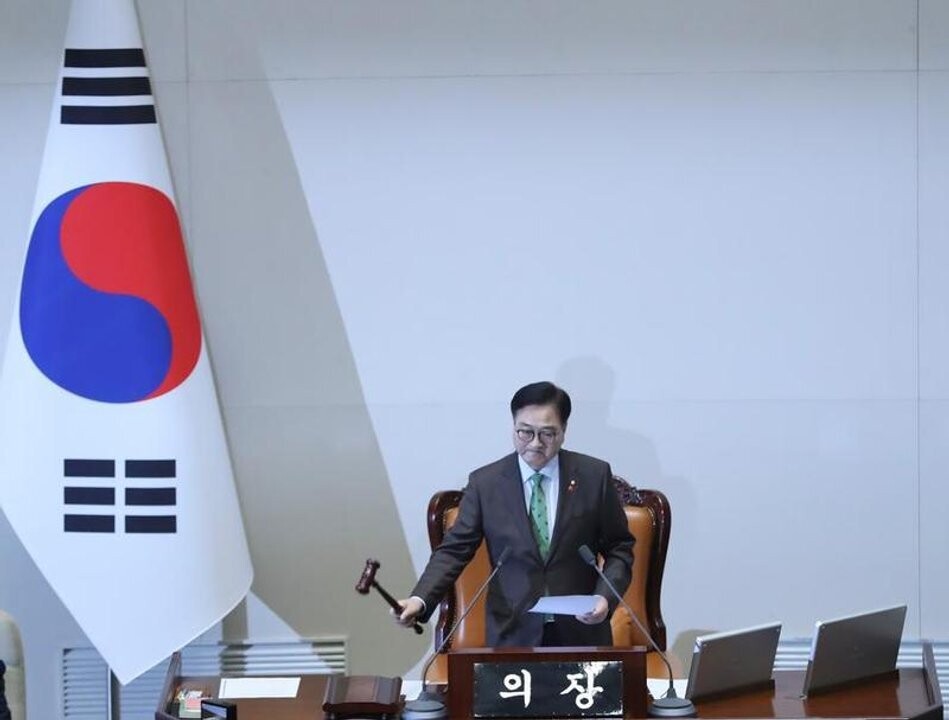
The President of the National Assembly of the Republic of Korea, Woo Won-shik, expressed concern over Japan's perception of history. In response to the recent statement by Japanese Prime Minister Sanae Takaichi that Dokdo was historically Japanese territory and in accordance with international law, Woo posted on social media that the Japanese government expanded the so-called 'sovereignty exhibition' that claims sovereignty over the Dokdo islets, learned today by Noticias Argentencia agency via Xinhua. Since the hall's inauguration in 2018, the Republic of Korea has demanded its closure on several occasions, but Japan recently added an educational space to the hall in an apparent attempt to instill incorrect perceptions in future generations, added Woo. 'For a stable and future-oriented relationship between (the Republic of) Korea and Japan, three pillars must remain firm: to face up to the painful history, to deepen economic cooperation, and to cooperate as partners for peace on the Korean Peninsula and in Northeast Asia,' Woo emphasized. Woo pointed out that the Republic of Korea will hold its own ceremony this year to commemorate the Korean victims of forced labor at the gold mines on Sado Island, given that Japan did not mention 'forced labor' in its commemorative speeches. South Korean historians clarified that thousands of Koreans were forced by the Japanese Empire to perform heavy labor at the gold mine, which was converted into a facility for manufacturing military materials during World War II when the Korean Peninsula was under Japanese rule. Woo also expressed concern over Japan's recent moves to revise its so-called pacifist constitution, something unacceptable not only for the Republic of Korea but also for all neighboring countries, as it disrupts the basis for the peaceful order in East Asia by transforming Japan into a country capable of waging wars. The Republic of Korea has long protested Japan's renewed territorial claims over the disputed islets located between the two countries, called Dokdo by the Republic of Korea and Takeshima by Japan. The Republic of Korea recovered sovereignty over Dokdo after the liberation of the Korean Peninsula from Japanese colonization in 1910-1945 and has since then exercised effective control over the islets, with a small police detachment deployed. South Koreans consider Japan's territorial claims over the islets as a denial of colonial history, given that Dokdo was the first territory forcibly occupied by that country.