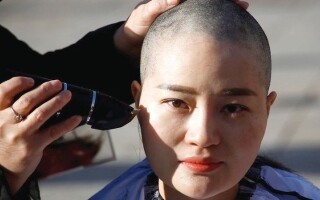
The tradition of political protests involving head-shaving has returned to the forefront in South Korea as local elections approach. However, some doubt the impact of such demonstrations, suggesting that this once-powerful political tool has lost its effectiveness. The latest politician to shave his head in public was Oh Jun-hwan, a candidate for mayor of Goyang city in Gyeonggi Province. Last Tuesday, while shaving his head outside the headquarters of the 'People Power Party' in Seoul, Oh claimed the party had excluded him from the mayoral race despite being the frontrunner in multiple opinion polls. He demanded 'fairness in the party's candidate selection process.' Oh was not the only politician to reject the party's nomination results. Former People Power Party lawmaker Kim Byung-wook also shaved his head after being excluded as a potential candidate for mayor of Pohang in North Gyeongsang Province. He similarly criticized the party's selection process as unfair, citing his polling performance. Likewise, North Chungcheong Province Governor Kim Young-hwan protested the party's decision to exclude him from the race for his current position. Following the announcement of his exclusion on March 16, Kim posted a video on Facebook showing himself getting a haircut at a local barbershop. In his post, he stated, 'Only the people of North Chungcheong can oust me from the race; we still have hope.' Meanwhile, current Busan Mayor Park Hyung-joon faced jeers for the first time in his two-decade political career on March 23 in front of the main National Assembly building in Seoul. Park criticized the Assembly, controlled by the liberal party, for delaying a special bill aimed at providing incentives for investments in Busan and improving its urban infrastructure. Park's complaint was that Busan was being discriminated against, considering that similar special bills to support North Jeolla and Gangwon provinces had already been approved by the parliamentary committee and were scheduled for a plenary session. Park's move came after Gangwon Governor Kim Jin-tae shaved his head last month to call for a special bill to encourage investment in Gangwon Province. On March 17, the People Power Party confirmed Kim's nomination for a second term as governor. Park is one of two party candidates in the race for mayor of Busan, alongside lawmaker Ko Jin-woo. While lawmakers and advisors were locked in heated political debates over launching mega-projects, some opted for a razor. Regarding the proposal to create a 'megacity' through the administrative merger of Daejeon and South Chungcheong provinces, Daejeon city council member Ahn Kyung-ja, of the People Power Party, appeared with a shaved head on February 12 to protest the unilateral pressure from the liberal bloc to merge the two administrative bodies. This followed similar actions by liberal politicians supporting the megacity plan, including Democratic Party lawmaker Park Bum-ki, who announced his candidacy for mayor of the newly merged megacity and shaved his head himself on February 28. However, the head-shaving efforts failed to change anything. The merger effectively fell through before the upcoming June local elections after Park withdrew his candidacy and decided not to run for any office in the next elections. An Old Custom Under the continued influence of ancient traditions, many South Koreans view head-shaving as a means to express a steadfast commitment to a specific cause. However, experts today largely doubt that this non-violent gesture carries significant political symbolism, representing strong will and sacrifice. They say voters no longer fundamentally believe that such protests can influence political decision-making.