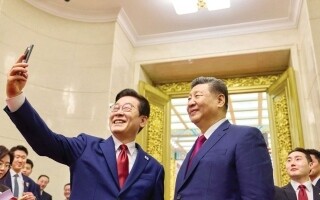
South Korean President Lee Jae-myung began the new year with a highly complex diplomatic mission that could challenge even the most seasoned leaders. He started with an official visit to Beijing, the first by a South Korean president since 2019, which was a direct continuation of a diplomatic campaign launched by Beijing towards South Korea's new government. During the visit, the Chinese discourse focused on the concepts of friendship and mutual benefit, emphasizing the expansion of economic and cultural cooperation between the two countries. President Lee was accompanied by a large delegation of about 200 top corporate leaders, clearly indicating the priority of economic interests. However, Chinese President Xi Jinping and his leadership did not hide their efforts to frame the relationship with South Korea within a shared historical context, recalling the two nations' past struggle against the Japanese Empire. The challenge for President Lee is that Japanese Prime Minister Takaichi adopts a clear confrontational approach towards China, a stance that is a pillar of the political alliance she leads in Japan. Nevertheless, President Lee appears to be successfully managing the complex relationship between China and Japan with a degree of balance and flexibility. In the capitals of Northeast Asia, as in Europe, there is talk of a new world order moving towards division into competing spheres of influence. Following his visit to China, President Lee traveled to Japan for a meeting seen as a potential breakthrough in bilateral relations. The meeting took place in Takaichi's hometown of Nara. While the leaders avoided contentious issues, real progress requires addressing them, starting with the issue of compensation for victims of forced labor and their families, which could lead to the seizure of assets from Japanese companies. Lee's strategy is to deepen relations with both Beijing and Tokyo simultaneously without getting drawn into direct regional conflicts or taking sides, possibly even helping to ease the existing tensions. This careful management of the trilateral relationship comes against a backdrop of an unstable international landscape, clearly seen in the interventionist policies of US President Donald Trump. These steps reflect a conscious attempt to redefine South Korea's position between two competing regional powers. It is clear that both China and Japan are vying for South Korea's favor, while President Lee finds himself forced to walk a fine line between the two. Despite some optimism, significant challenges remain, with the understanding that real progress requires tackling the difficult historical and regional issues.